PART THREE: Basic Laws of Common, Everyday Objects
- Hard-top cars are funnier than convertibles.
- Small wheels are funnier than big wheels.
- Pickup trucks are not funny. Never draw pickup trucks.
- Machines are funny when they have gears, belts, oversized duct work, and large levers with red balls on the end.
- A flashing light on top makes any machine funnier.
- Anything gross, like feces or a rotten hunk of meat, is funnier with a fly buzzing around it.
- Meat is funnier than vegetables.
- Buildings, trees, and scenery are not generally funny. (Don't even bother to draw a background unless it's absolutely required.)
- Overstuffed, high-backed chairs with spiral-tucked arms are essential to funny living-room scenes.
- Safes and just about anything with a dial on it are funny, especially when falling on someone's head. (See Part Three-and-a-Half below.)
- Sometimes an object that is unfunny, like a suitcase or a file cabinet, can be made funny by putting a face on it. Be careful: Most things will just look "cute" with a face on them. Use this technique sparingly.
PART THREE-AND-A-HALF: Basic Laws Concerning Threatening Objects
- A knife is funnier than a gun.
- A spiked mace or a cat-o'-nine-tails is funnier than a knife.
- A board with a nail through it is funnier than a spiked mace or a cat-o'-nine-tails.
- A large mallet is funnier than a board with a nail through it.
- Bombs of all kinds are funny, especially ones with lit fuses. Explosions, however, aren't really very funny no matter how clever the sound effect.
- Anvils, pianos, two-ton weights, or monstrously oversized things, like a can of Spam the size of an automobile, are only funny with people completely flattened by them underneath.
- Bullets making holes through a victim are funnier than spurting blood. (Bullet holes should be at least twice as big as the bullet.)
Principles in Effect
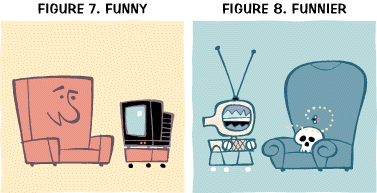
Special bonus comedy tip: Old technologies (rotary phones, room-sized computers, cars with fins, old-style hi-fi record players, etc.) are funnier than new technologies.
Basic Laws of Charts and Graphs
|