|
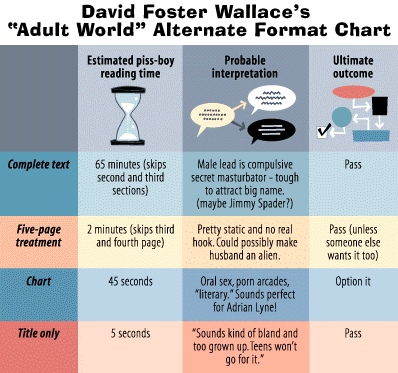
Or consider how increasingly aggressive chart utilization could make largely
ignored aspects of the contemporary magazine, such as the short story, more
reader-friendly. In the July issue of Esquire, literary Edison David
Foster Wallace points toward a possible future with a short piece of fiction
entitled "Adult World." While the story's first three sections are presented
in a static, deliberately repetitious, fairly traditional manner, the fourth
assumes the form of an outline: "2b(1) Tone of F. L.'s confessions tremndsly
moving & high affect, & J. (even though traumatized w/r/t (1b) & (1c)'s
epiphany) never once doubts the truth of what he says," reads one pivotal
passage. But even it seems unnecessarily prolix - that "never once doubts
the truth of what he says" could easily be condensed to "never doubts him,"
for example. The unforgiving spatial constraints of a chart would have
forced Wallace to give his prose the sense of extreme, tight abstraction he
appears to be seeking; the headings of each column and row would have
provided him with the opportunity to convey his writerly intentions with an
even greater degree of bold-faced clarity than he manages via his
last-minute preconstruction. Literary purists may resent such progress, but
the audience that authors really write for - the movie studio piss boys
charged with wading through every new copy of The New Yorker,
Texas Monthly, and Outside in search of the next Matt Damon
vehicle - will no doubt rejoice.
 |
![[Previous Page]](/daily/98/08/14/prev.gif)
![[Fresh Fish]](/daily/images/fresh_fish3.gif)